
Everyone in the third sector talks impact. Almost no one knows how to measure it, and those who demand the measurement do not always decide by it. A story about rats, foundations, and one word that has outgrown its own measurements.
In 1902, the French colonial administration in Hanoi resolved to rid the city of the rats infesting its sewer system. The solution was rational and measurable: one cent for every rat exterminated. To spare the municipal clerks from drowning in carcasses, it was decided that presenting a tail would suffice. Tails poured into city hall by the thousands, and the reports looked superb. Only one thing troubled the officials: healthy, cheerful rats had begun to roam the streets, minus their tails. The residents had grasped very quickly that a living rat is an income-producing asset. Snip, release, and it carries on breeding. On the outskirts of the city, rat farms were already in business, and the program was scrapped. The historian Michael Vann, who unearthed the affair in the French archives, proposes calling the phenomenon “the rat effect.”
Granted, most of us do not administer a colony in Southeast Asia. But anyone who works with nonprofits and foundations in Israel knows all too well the moment when tails are counted on a slide and victory is declared in the war on rats. Or, as it is known in the trade: we have demonstrated impact.
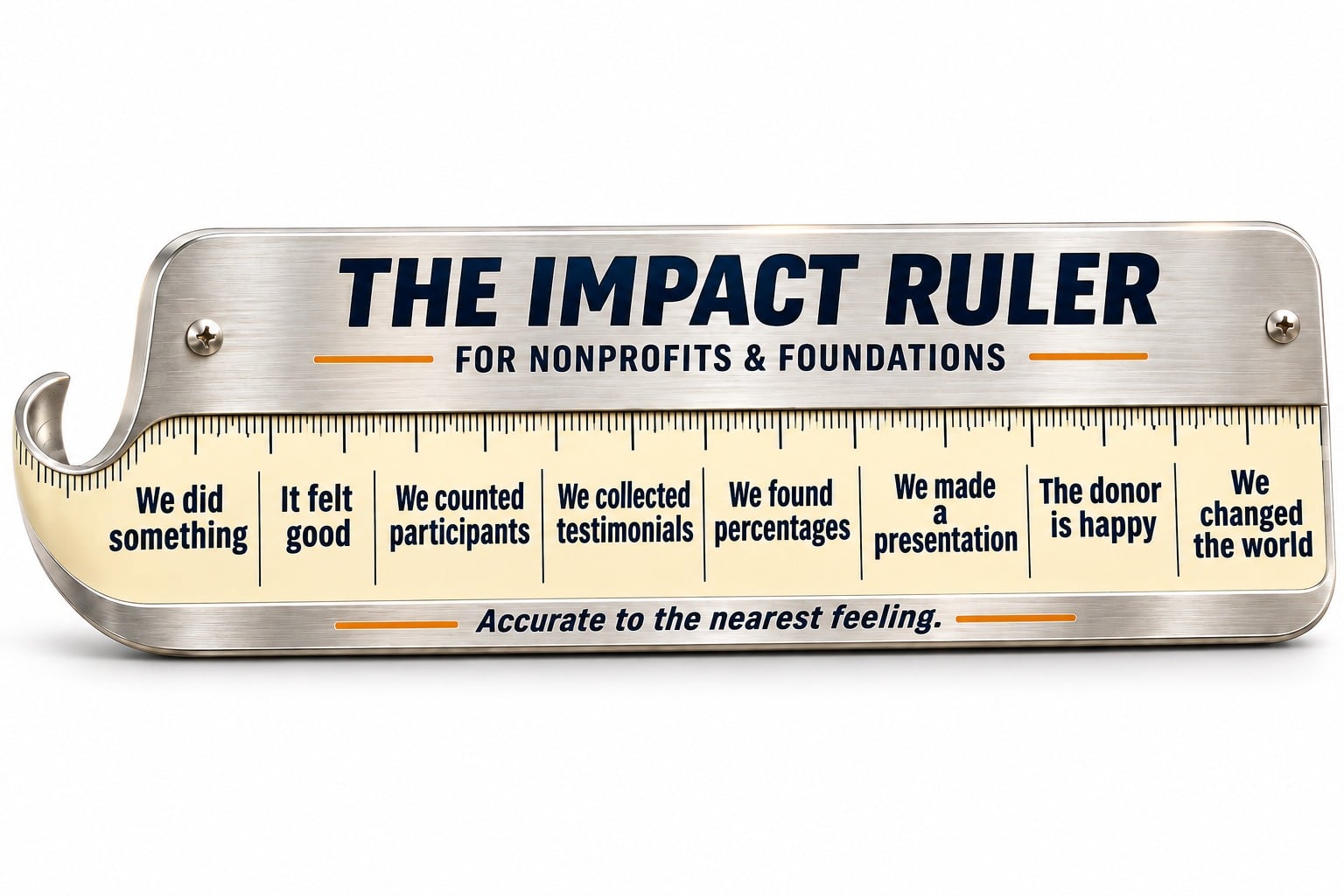
What Is the Impact Metric? Mission Impossible
We have been working with third-sector clients for many years, particularly nonprofits that seek to shape the public conversation in Israeli society, Jewish identity, and shared life. My established custom is to present the nonprofit’s leadership, at our very first meeting, with my book We Sparked a Conversation, a hefty volume that purports to profile 100 nonprofits that succeeded in sparking a public conversation in Israel. They discover soon enough that the book is blank. Why? Because most nonprofits fail to grasp how complex and presumptuous the mission is, and how much thought, resources and patience it demands. Those who do grasp it are the philanthropic foundations that fund them. Which is why they try, and rightly so, to understand what the “impact” of the work they support will be, to make sure their money is not being tossed into the recycling bin of good intentions.
The result: at the close of every reporting period, the nonprofit is required to present its funder with data on its activity, with an emphasis on “impact” metrics. How is impact measured? The foundations do not supply the formula. The nonprofit, being the one in the field, is the one required to prove it. And what do nonprofits that promote values through content do? They build a menu. Here, for instance, is a story based on a real case: a nonprofit whose periodic impact report we recently produced.
For the starter, we served the customary figures: visits, views, dwell times, and engagement rates that left the benchmark sitting on the bench. “Lovely,” they told me. “You’ve shown that you reached a lot of people, and you even have metrics showing they actually consumed the content. But did the content influence them?” Influence over opinions and worldviews is a highly fluid thing, and very hard to measure directly. But we found a non-direct way: for the main course, we served a quantitative and qualitative survey of a sample of several hundred members of the channel’s registered community, diverse in age, gender, religious identity, political stance and place of residence. The answers confirmed, from several angles of inquiry, precisely what the channel exists to advance: respondents described the added value the content gives them, and ranked highly the topics that touch on beliefs, opinions and worldviews. “Lovely,” they told me, “but you asked the channel’s fans. That is hardly an indicator from which one can learn about the target audiences at large.” So for dessert, we brought into the study people who do not subscribe to the channel and were exposed only to individual videos shown to them in the questionnaire, on which they were then questioned. The results? They corroborated the claim. “Lovely,” they told me, “but you haven’t proven that people’s opinions on particular issues actually changed, and that this happened specifically because of the channel’s content.” The foundation relished every course, and the data still left it hungry.
And the truth? Everyone is right. The nonprofit presented a great deal of circumstantial evidence but no direct evidence, and for good reason. To measure influence seriously, one has to follow a large and diverse group of specific individuals over many years, personal interviews included. That is a substantial undertaking for a major research institute, not for a nonprofit tending its own field. On hearing this argument, the foundation’s people nodded with understanding, and asked that the next report contain more impact.
Impact: A Buzzword That Is Hard to Stand Behind
What, in fact, is “impact”? There are various ways to define the term, and one of the most widely accepted is that “because of us, something happened in the world that would not have happened without us.” In that spirit, Mary Kay Gugerty, a professor of nonprofit management at the University of Washington, and Dean Karlan, an economist at Northwestern University, write that impact implies causality between an outcome and an action, and therefore requires estimating what would have happened without the program.
Karlan, as it happens, is a devotee of measurement. He founded Innovations for Poverty Action, an organization that has run hundreds of controlled trials, and the two state explicitly that the trend toward wanting to measure impact is, for the most part, a positive one. And yet, in an article published in 2018 in the Stanford Social Innovation Review under the title “Ten Reasons Not to Measure Impact—and What to Do Instead,” they conclude that the pressure to prove impact has wasted resources, come at the expense of routine monitoring, and spawned measurement methods that are poor and even misleading, and that much of the waste stems from overuse of the word itself. In the same article they concede, with rare candor, that even Karlan’s own organization cannot determine what would have happened had it never been founded. If the people who developed the measuring tools say so, what is the director of a nonprofit supposed to say, with a budget already stretched to its limit for the sake of the work itself and no surplus from which to conjure a research and evaluation department?
Until the birth of “impact,” foundations asked nonprofits to itemize outputs: how much we did, how many we reached, how many benefited from the service. These are figures that do give a foundation a view of how its money is being used. “Impact” introduced uncertainty into the arrangement: a metric that foundations demand to receive without themselves knowing how to measure it. My contention is that in these domains, of discourse and attitudes, it is simply not measurable at the level of the individual nonprofit, only through a long-term view of an entire field. The conclusion: impact should be measured by the foundations, across a whole field, rather than assigned to any one nonprofit. It is rather like asking the violinist to file a report on a symphony produced by an entire orchestra.

Why Here, of All Places? Because Nobody Ever Changed Their Mind Over a Video
The claim needs fencing in: it does not hold for every field or every nonprofit. A nonprofit that distributes food, vaccinates children or assists trauma survivors brings about something immediate and measurable in people’s lives. Alnoor Ebrahim and Kasturi Rangan, then at Harvard Business School, built an entire framework on this distinction. In their view, it is neither feasible nor even desirable for every organization to measure impact, and some organizations would do better to measure outputs and short-term outcomes. Systemic impact, they add, is better measured by the funders themselves.
Eric Nee, managing editor of the Stanford Social Innovation Review, put the difference simply: it is fairly easy to measure how a food bank affects the lives of the people who rely on it, and a good deal harder to measure how a news site affects the lives of its readers. Only rarely, Nee writes, is there a causal link between an article or a series of articles and public opinion, policy or legislation. In the field of discourse and influence, the difficulty is not technical. It is inherent and essential. Attitudes are built slowly and cumulatively, out of hundreds of encounters with ideas, people and events.
There is also a problem at the root. People themselves, by virtue of being human, are unable to look inward and analyze accurately whether their attitudes have changed, in what way, and on account of what. In a seminal 1977 paper, the psychologists Richard Nisbett and Timothy Wilson showed that human beings have no direct access to the processes that shape their judgments, and that when they explain what influenced them, they rely on plausible conjecture rather than on introspection. In 1983 the sociologist W. Phillips Davison described the “third-person effect”: people tend to assume that media messages affect others more than they affect themselves, particularly when the influence is seen as undesirable. Whoever asks in a survey “Did this content change your mind?” sets off a resistance mechanism that skews the results.
There is, of course, another way: experiments. One can show a video to a random half of a panel and compare attitudes immediately afterwards. This requires a rigorous experiment, and it measures an immediate response to a single stimulus. It is quite similar to the questionnaire in which we showed a video to incidental respondents and asked them about it, but it does not test long-term influence, and certainly not matters of identity and values. Anya Schiffrin of Columbia University and Ethan Zuckerman, then at MIT, who surveyed the attempts to measure the influence of news organizations, distinguish between reach (how many people consumed the content), influence (how it affected public discourse) and impact (whether it contributed to a change in policy or to the building of a movement). On paper, that is right: there is such a thing as clear impact, visible to the naked eye. The moment the state changes policy and adopts a model born in a nonprofit, for instance, or an entire field is transformed by the disruptive activity of a single organization. But that is the very summit of impact. It is quite rare, and it almost always arrives after many years of activity, and most certainly not in a quarterly measurement.
The bottom line: the standard metrics were not designed to measure “impact,” which yields an absurdity. What can be measured simply, from the numbers the platforms hand out, is not what we want to know, and what we want to know requires arduous, comprehensive research that no one is offering to fund.
And patience is required. A great deal of it. Schiffrin and Zuckerman sum up the research thus: social change usually unfolds over decades, and media coverage has an effect only when other social forces are at work alongside it. A grant from a philanthropic foundation, by contrast, lasts a year, sometimes three, and the reporting is quarterly. The foundation asks to see, within the grant cycle, a result that by its nature cannot appear in it. It is like planting an olive sapling and demanding a comprehensive harvest report at the end of the first quarter. And while we are at it, how has olive consumption affected users’ health and their attitudes toward salad dressing? Kindly answer using Analytics metrics.

Measurement Bias: When Measuring Impact Sabotages the Work
“Oops.” That is the word that opens a 2016 article by Caroline Fiennes and Ken Berger. The authors are veteran supporters of the “impact revolution,” and Berger even headed Charity Navigator for almost seven years.
What is the “oops” about? The revolution that went wrong. We asked nonprofits to evaluate their own impact, Fiennes and Berger write, but the research a nonprofit produces serves in practice as marketing material aimed at funders, in order to win support. The nonprofit works to prove impact by murky metrics, rather than to bring about the change it knows how to bring about on the ground. If its perfectly worthy activity fails to move the “impact metrics” enough, the nonprofit will stop doing what it is supposed to do.
If, for example, the foundation declares “social media engagement” to be the leading metric for the “impact” of content, the nonprofit will begin producing material that generates engagement, even if that is not the material actually needed to advance its goals. If the foundation asks for website visits to be measured, visits are what the nonprofit will manufacture. I am fairly certain this is how clickbait was born. Plenty of tails, precious few of the results we actually wanted.
A famous example of measurement altering the work itself occurred in the early 1990s, when New York and Pennsylvania began publishing cardiac surgery outcomes at the level of the hospital and the surgeon, in the name of transparency and accountability. Four economists examined what happened next and published their findings in 2003 in the Journal of Political Economy: publication gave doctors and hospitals an incentive to steer clear of the sickest patients, the ones liable to spoil the average, and they did indeed begin selecting their patients. Alongside some improvement in the matching of patients to hospitals, the net result was greater use of resources for worse health outcomes, chiefly for the sickest patients. And it is happening before our eyes in education as well: struggling students are nudged down to a lower track, pupils are drilled for the assessment rather than taught the material itself, and groomed for the school’s excellence metrics instead of for life.
Measuring Impact: What Does It Cost Us?
Alongside the professional difficulty of measurement, there is also the matter of cost.
State of Evaluation, a national survey by Innovation Network, was conducted in 2016 among 1,125 American nonprofits. Its authors recommended devoting 5 to 10 percent of an organization’s budget to evaluation. In practice, 84 percent of nonprofits devoted less than 5 percent to it, and some 59 percent less than 2 percent, including 16 percent that devoted nothing at all. Only 6 percent of the nonprofits that evaluate have an internal staff member whose job it is.
The trap is hardly surprising. The funder demands the product of serious research, but a research line of that kind in the budget would count, in its eyes, as overhead: money not going to the work. The nonprofit submits what two percent can buy, and the foundation is disappointed by the imprecise metrics.
Were this merely a superfluous ritual, one could shrug. But as in Hanoi, the ritual carries a price that is not only financial. It tilts funding toward nonprofits whose services are easy to measure, it wastes resources, it precludes long-range thinking, and worst of all, it breeds a culture of pretense: nonprofits learn to phrase successes, and foundations learn to read them with one eye half-closed, everyone knowing full well that the Emperor of “Impact” has no clothes, or at the very least is parading about in nothing but a bikini. Trust, which measurement was meant to build, is being eroded by measurement itself.
Fairness requires saying that the pressure on nonprofits to measure “impact” has also done some good. The impact discourse replaced “we do good, trust us,” and forced organizations to ask themselves whether they are of any use at all, and whether the work they have always done deserves to continue. That is a question worth continuing to ask. But in the field of discourse and influence, today, the price paid along the way exceeds the return.
So What Do We Measure? Five Rules for Impact-Supporting Evidence
What, nonetheless, can and should be measured in order to build an “impact picture”? Here are the pieces of circumstantial evidence which, in one combination or another, can add up to a reasonable one.
1. How and who, not just how many. View counts say little; quality-of-consumption metrics such as dwell time say a good deal more. But audience composition offers another important angle: how much of the activity reaches the audience you defined in advance as the target.
2. Return, not exposure. If attitudes are built cumulatively, the metric closest to the mechanism of influence is who comes back: the return rate, the length of the relationship, and the depth of consumption over time. A one-time viewer is an exposure. Someone who has come back 30 times is in a process.
3. Traces in the discourse. Have media outlets quoted anything from your content? Are teachers, facilitators and professionals using the material? Has another organization requested, or simply taken, a figure from you? These are facts that can be documented, and they offer a further view of “impact.”
4. Ask the audience, bias and all. Declining to ask the people already identified with you and connected to you, on grounds of bias, means missing a significant focal point. True, the findings cannot be lifted as they stand and applied to the general population. But if the audience most attached to you reports being influenced, that is a good sign. And if not even they do, that is a very bad one.
5. Call each thing by its name, then interpret. Outputs are reported as outputs. Reach figures as reach figures. Quality metrics as quality metrics. Begin by comparing apples with apples and oranges with oranges, and from there proceed to the larger question of how the data connect, and to finding the narrative the data are probably telling. That part is written in words, as an argument one is free to dispute.
These rules have research behind them as well. Gugerty and Karlan recommend that nonprofits collect, in place of proof of impact, data on who actually participates, how engaged they are, and what they have to say.
And one caveat, in the spirit of Campbell: the moment these rules become a condition of funding, they too will be corrupted, and nonprofits will learn to turn out “returning visitors” and “mentions” at an industrial pace. They are useful so long as they serve learning, and lose their value once they become the grade that is the be-all and end-all.
The Rule Is Simple
“What is the impact?” I will be asked again next quarter. I will answer as best I know: whom we reached, who came back, where things left traces, what the audience itself says, and why I think all of this contributes to the change we all wish to see. If that is persuasive, fund it. If not, don’t. A sector whose very existence rests on trust, and on the understanding that every nonprofit knows its own particular work best, cannot afford for its most ubiquitous word to be its least honest one.